
Written by Maureen Onyango, CFK Africa’s Communication and Advocacy Lead
George Bahati still remembers the moment his work as a teacher changed.
It came in an ordinary class meeting with Grade 3 learners, the kind where children talk about their weekend. Some of them mentioned that others were “playing Kalongo” and “doing bad manners“. George did not know the first phrase. It was a children’s word, the kind that circulates in a playground and never reaches a staffroom. He could have let it pass, but something in the way one of the girls said it made him stop.
She was eight years old.
He called her aside. A man from their plot would wait until her mother was out, promise her sweets, and then abuse her. When George asked why she had never told her mother, she said she was afraid her mother would beat her.
Playing Kalongo, he learned, was what the children called sex.
George teaches in Kibera at one of the 47 schools supported through CFK Africa’s Best Schools Initiative. He calls that first case his baptism by fire.
“My name is George Bahati. I work with teachers and children, and I mostly interact with them at school,” he says.
As deputy head teacher, his days are full: lessons to plan, learning gaps to close, enrolment to watch, the wellbeing of teachers and children to keep an eye on. Over time, he has come to see that a teacher’s work does not end with the timetable. Sometimes it begins when a child says something quietly and an adult chooses to listen.

He did not plan on teaching. His aunt pushed him towards it; what he wanted to do was film production. He trained in Education to please her, then went back to what he loved, and found himself teaching children film, acting and production.
“That is when I realized teaching is a calling,” he says. “When you try to run away from your calling, you often find yourself drawn back to it.”
The child protection work began the same way, without him choosing it. Children trusted him with pieces of their lives, and the more he listened, the more he understood how much they were carrying. The stories rarely came out directly. They came through play, through jokes, through silence, through his attention to each child and noticing behavior that did not fit.
That pushed him to train in child protection. George enrolled into training lessons with organizations such as Feminist for Gender, Mathare Social Justice and Kenya National Commission on Human Rights (KNCHR). He learned what warning signs look like, how to respond, and what to do next.
Knowing what to do did not make it easier. The work required courage, good contacts, and a willingness to speak when silence would have been safer. In one case, he says, he was offered money to drop the matter. There was pressure to accept it and let the case end quietly. George refused.
“Sometimes you find yourself wondering, what if I had taken the money?” he says.
He kept going. After reporting the eight-year-old’s case to the children’s office, he followed it closely. One night he got an anonymous call, a stranger asking a lot of questions and giving no name. The next morning, several officials handling the case had called to ask who he was connected to.
He has handled five cases in the past two to three years. Two were serious enough that he could not manage them alone. Every one that reaches justice tells him the persistence was worth it.
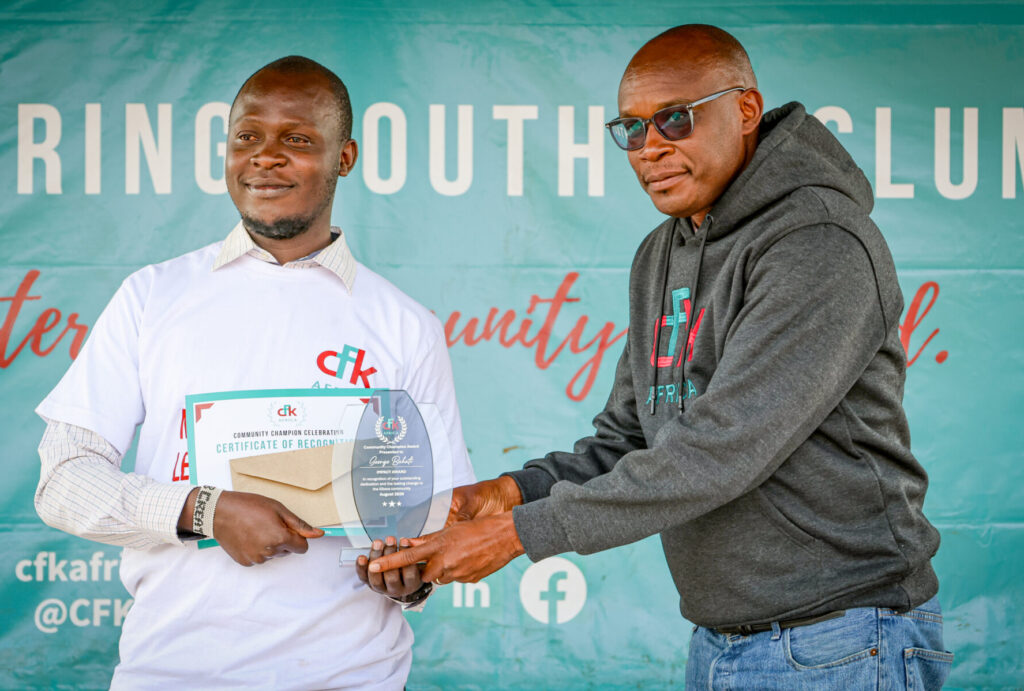
2026 Community Champion: Impact Award
In August 2026, CFK Africa recognized George with the Impact Award for his work on child protection and safeguarding. The nomination came from the people around him, teachers, parents and community members who had seen what he does when a child speaks up. He wants to build something with lasting sustainability now -a program that reaches children who are being harmed and makes it easier for them to get protection, justice and counselling.
“We need support in connecting with organizations that work with children and handle these sensitive cases,” he says. “By working together, we can create stronger referral pathways and achieve greater impact.”
His advice to anyone who wants to do this work is short. Be bold, be decisive, be smart. Do not come in expecting something back, but know that you are changing a child’s future for the better
George’s story is about one teacher’s courage and what becomes possible when adults closest to children are trained, alert, and know who to call. Children do not always name harm clearly. Sometimes they use the only words they have, and hope someone is listening.
George listened. Because he did, a child’s story did not stay hidden inside a classroom conversation.
***In honor of our 25th anniversary in 2026, this story is #16 of 25 Stories of Change, shared throughout the year and featuring youth and communities whose lives have been transformed by CFK Africa.