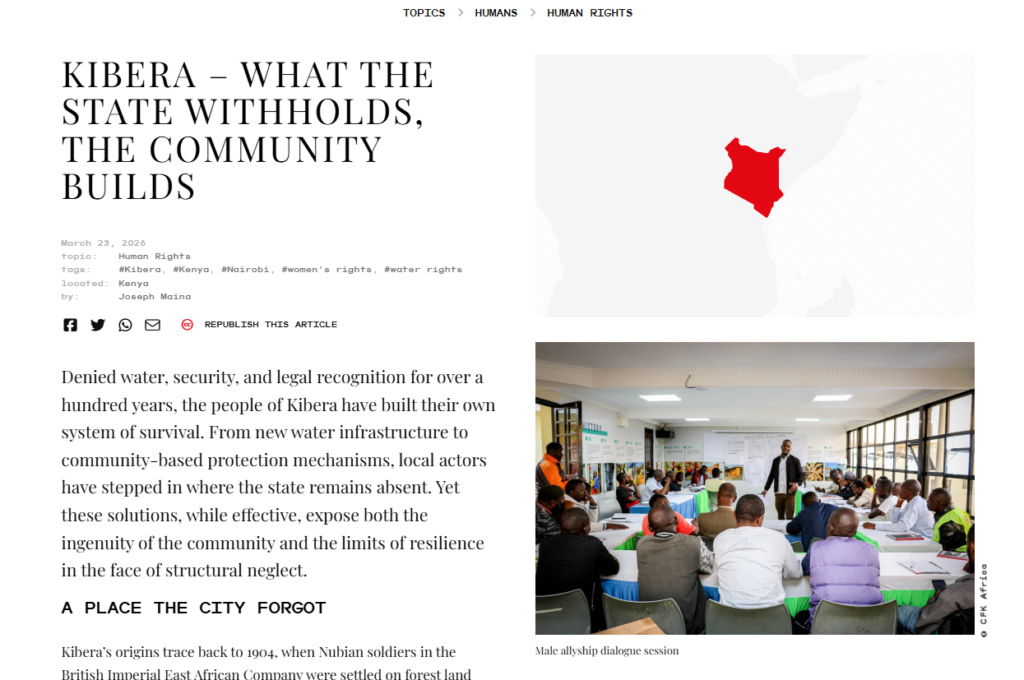
A Community-Led Response to Gender-Based Violence
…Another community response addressed the silence around gender-based violence, and it worked through an actor the formal system had overlooked: the landlord.
CFK Africa’s compound-to-compound initiative trains landlords in Kibera as responders to domestic abuse and sexual violence. ‘Landlords live near or within compounds and often learn about violence early through noise, distress, tenant disclosures and neighbour reports,’ the organisation explained to FairPlanet. ‘In the slums, landlords control access points, making them practical actors in prevention and early intervention.’ In a place where survivors fear police, where the nearest hospital is outside the settlement, and where reporting abuse can mean losing a home, a trained landlord with a referral pathway is often the only first response.
The training covers Kenya’s Sexual Offences Act, privacy rights, survivor-centred referral principles, and a structured framework for responding to disclosures. Crucially, it also engages landlords as male allies – deliberately shifting the burden of safety from the women who have been carrying it alone. After a case is flagged, referrals are channelled to police gender desks, health facilities, legal partners for protection orders, and safe houses where needed.
In 2025 alone, 92 referrals were made through the programme. CFK Africa has trained 40 landlords in Kibera, and a further 80 across Mathare, Mukuru, and Kajiado. Researchers studying community allyship internationally have taken notice: a 2024 academic study conducted in the Democratic Republic of Congo, found that the most effective allies against gender-based violence are not outside experts but trusted local figures who mobilise their community’s own values and structures – which is precisely what the CFK Africa model does.
Read the full article on Fair Planet.